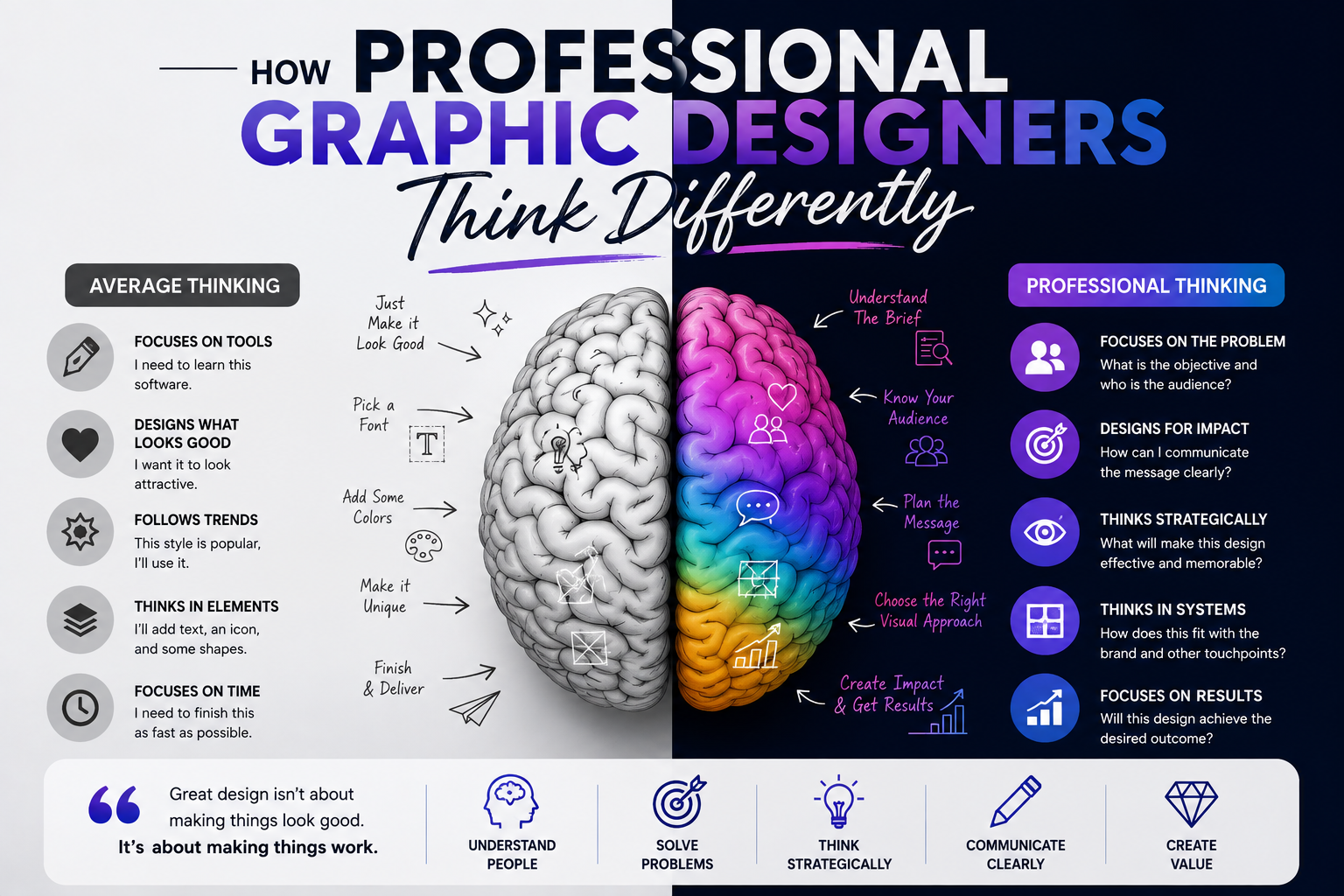
How Professional Graphic Designers Think Differently
What makes someone a professional graphic designer?
Is it knowing Photoshop?
Being creative?
Having a good eye for color?
Knowing typography?
Using the latest AI tools?
These skills certainly matter.
But professional graphic designers think differently from people who simply know how to create attractive visuals.
They don't start with:
“What should I make?”
They start with:
“What problem am I trying to solve?”
That's one of the biggest differences between designing something that looks good and designing something that actually works.
A professional designer thinks about the audience, purpose, message, context, business objective, and user behavior before thinking about colors, fonts, or effects.
And in 2026, this mindset is becoming even more important because AI has made visual production faster than ever.
When almost anyone can generate an image in seconds, the ability to think like a designer becomes more valuable.
Here are some of the ways professional graphic designers approach their work differently.
1. They Start With the Problem, Not the Design
An inexperienced approach might be:
“The client needs a social media post. Let's make something attractive.”
A professional approach is:
“What does this post need to achieve?”
Maybe the goal is:
- Generate leads
- Introduce a product
- Build awareness
- Explain a service
- Increase engagement
- Drive website traffic
- Establish trust
- Make an offer more understandable
The visual direction depends on the objective.
A beautiful design that doesn't communicate the intended message isn't necessarily a successful design.
Professional designers solve communication problems.
2. They Think About the Audience Before Themselves
Designers can easily fall into the trap of designing what they personally like.
But the designer isn't always the target audience.
A professional asks:
Who will see this?
What do they already know?
What do they care about?
What might make them stop scrolling?
What could confuse them?
What action do we want them to take?
This changes the entire design process.
A designer isn't simply asking:
“Do I like this?”
They're asking:
“Will this work for the intended audience?”
3. They Understand That Design Is Communication
Graphic design is visual communication.
Every element has a job.
Typography communicates personality.
Color establishes mood.
Images provide context.
Spacing creates hierarchy.
Composition controls attention.
Contrast creates emphasis.
A professional designer doesn't randomly place elements until the design “looks right.”
They create a visual hierarchy that guides the viewer.
For example:
What should people notice first?
What should they read second?
What information can be smaller?
Where should their eyes go next?
This is design thinking in action.
4. They Know When to Remove Things
One of the hardest skills in graphic design is knowing what not to include.
Adding another:
- Font
- Color
- Icon
- Shadow
- Gradient
- Graphic
- Animation
- Decorative element
can make a design feel more exciting.
But it can also make the message harder to understand.
Professional designers often improve a design by removing unnecessary elements.
They ask:
“Does this element help communicate the message?”
If the answer is no, it may not belong there.
5. They Don't Confuse Complexity With Creativity
A complicated design isn't automatically a creative design.
Sometimes the most difficult solution is actually the simplest one.
Professional designers understand that creativity isn't about adding more.
It's about finding a better way to communicate an idea.
A simple visual concept with strong reasoning can be more effective than a highly detailed composition with no clear purpose.
This is particularly important in branding.
A logo needs to be recognizable and functional—not simply impressive when viewed at a large size.
6. They Think About Context
A professional designer doesn't judge a design only on their monitor.
They think about where the design will actually exist.
A social media graphic might appear on a small phone screen.
A logo might be printed on packaging.
A billboard might be viewed from a distance.
A presentation might be displayed on a projector.
An advertisement might be seen for only two seconds while someone is scrolling.
The same design can perform differently in different environments.
Professional designers think beyond the canvas.
They think about where, when, and how people will experience the design.
7. They Design for Human Behavior
People don't interact with designs like designers do.
They don't usually examine:
- Grid systems
- Kerning
- Alignment
- Color theory
- Negative space
- Typography choices
Instead, they quickly scan and make decisions.
They ask themselves:
What is this?
Is it relevant to me?
Can I understand it quickly?
Should I keep looking?
Should I click?
Professional designers understand these behaviors.
They use hierarchy, contrast, composition, imagery, and typography to guide attention.
The design isn't just created for the eyes.
It's created for people.
8. They Think About the Business, Not Just the Visual
A professional designer understands that design exists within a larger business system.
A social media advertisement isn't successful simply because it looks good.
It needs to support a marketing objective.
A website isn't successful simply because it looks modern.
It needs to help users find information and take action.
A logo isn't successful simply because it looks beautiful.
It needs to help establish a recognizable brand identity.
This is why professional designers learn about:
- Marketing
- Branding
- Consumer behavior
- Business objectives
- Content strategy
- Advertising
- User experience
The more a designer understands the business problem, the better their design decisions can become.
9. They Ask Questions Before They Open Photoshop
This is one of the biggest differences between a professional designer and someone who simply knows design software.
A professional might ask:
What is the objective?
Who is the audience?
What is the key message?
Where will this be used?
What action should the viewer take?
Who are the competitors?
What should the brand feel like?
What must be avoided?
These questions can save hours of unnecessary design work.
Sometimes the biggest improvement to a design project happens before the designer creates anything.
10. They Don't Chase Every Design Trend
Design trends can be useful.
But professional designers understand the difference between a trend and a strategy.
A visual style might be popular today and feel outdated next year.
If every brand follows the same trend, differentiation disappears.
Professional designers ask:
“Does this trend help the brand?”
rather than:
“Is everyone using this?”
Trends can be tools.
They shouldn't become the strategy.
11. They Understand That Consistency Matters
A single great design doesn't build a strong brand.
Consistency does.
Professional designers think about how different pieces of communication connect.
For example:
Logo → Website → Social Media → Advertising → Packaging → Presentation
These shouldn't feel like completely different companies.
They should share a recognizable visual language.
This is why professional designers often build systems rather than individual designs.
They create rules that make future content easier to produce while keeping the brand consistent.
12. They Think in Systems
A beginner might think:
“I need to design this Instagram post.”
A professional might think:
“How can I create a system that allows us to produce 50 posts while maintaining consistency?”
This is a major shift.
Instead of designing everything from scratch, designers can create:
- Templates
- Components
- Grids
- Typography systems
- Color systems
- Layout rules
- Design guidelines
- Reusable assets
This makes design more scalable.
13. They Know That Feedback Is Part of the Process
Professional designers don't treat feedback as a personal attack.
Design is collaborative.
Clients, marketers, developers, content teams, and other stakeholders may have information that the designer doesn't have.
The professional response isn't:
“I don't like your suggestion.”
It's:
“What problem are we trying to solve with this change?”
Sometimes feedback improves the design.
Sometimes the designer needs to explain why a suggestion could hurt the objective.
Either way, the conversation should focus on the design problem, not personal preference.
14. They Use AI Differently
This is perhaps the biggest change happening in graphic design.
AI can now help designers with:
- Concept generation
- Image creation
- Background generation
- Retouching
- Image expansion
- Creative exploration
- Copy variations
- Moodboards
- Video concepts
- Production tasks
But professional designers don't necessarily use AI to replace their thinking.
They use it to extend their thinking.
Instead of:
AI creates everything → designer chooses one.
The stronger approach is:
Designer defines the problem → AI explores possibilities → designer evaluates → designer refines → final design serves the objective.
AI can produce options.
The designer still needs to decide which option makes sense.
15. They Know That AI Output Isn't Automatically Good Design
AI can generate something visually impressive in seconds.
That doesn't mean it's strategically correct.
A designer still needs to evaluate:
- Composition
- Typography
- Hierarchy
- Brand consistency
- Visual accuracy
- Audience relevance
- Emotional tone
- Originality
- Usability
This is why AI literacy is becoming part of modern design expertise.
The future isn't necessarily:
AI vs. Designers
It's increasingly:
Designers who understand AI vs. designers who don't.
16. They Study People, Not Just Design
Professional designers don't only look at other designs.
They observe people.
They pay attention to:
- How people use products
- How people interact with websites
- What makes people stop scrolling
- How people react to advertisements
- How people navigate spaces
- What visual information they notice first
Because ultimately, design is created for humans.
The better you understand people, the better you can communicate with them visually.
17. They Know That “Beautiful” Is Not the Final Goal
A design can be beautiful and still fail.
A better question is:
Did it accomplish what it needed to accomplish?
If an advertisement generates attention but doesn't communicate the product, it has a problem.
If a website looks beautiful but users can't find information, it has a problem.
If a logo looks impressive but becomes unreadable at small sizes, it has a problem.
Professional designers measure success through purpose and performance, not aesthetics alone.
18. They Keep Learning
Design doesn't stop changing.
New:
- Software
- AI tools
- Platforms
- Formats
- Visual trends
- Consumer behaviors
- Marketing strategies
continue to appear.
Professional designers don't need to master every new tool.
But they need to understand what is changing and why it matters.
The goal isn't to chase every new technology.
It's to remain adaptable.
19. They Build Taste Through Observation
You can learn software relatively quickly.
Developing strong visual judgment takes much longer.
Professional designers continuously expose themselves to:
- Branding
- Architecture
- Photography
- Film
- Typography
- Packaging
- Editorial design
- Advertising
- Art
- Technology
- Culture
Over time, this builds visual awareness.
They begin to notice things that others overlook.
Why does this layout feel balanced?
Why does this logo feel premium?
Why does this advertisement feel trustworthy?
Why does this composition feel uncomfortable?
That ability to evaluate visual decisions is part of professional design thinking.
20. They Understand That Design Is a Process
The final design is only one part of the work.
Behind it is usually:
Research → Strategy → Ideas → Exploration → Design → Feedback → Refinement → Delivery
Sometimes the final solution looks simple.
That doesn't mean the process was simple.
In fact, professional design often involves removing complexity until only the most useful elements remain.
Professional Designers Don't Just Design
The biggest difference can be summarized in one sentence:
A beginner focuses on making something look good.
A professional focuses on making something work.
That's the mindset shift.
Professional designers think about:
- Problems
- People
- Purpose
- Context
- Business
- Communication
- Psychology
- Systems
- Technology
- Results
And now, with AI changing how quickly visual content can be produced, these skills are becoming even more important.
AI can help you create faster.
But it doesn't automatically tell you what should be created, why it should exist, or whether it actually works.
That's where professional design thinking comes in.
Final Thoughts
Professional graphic designers don't necessarily have some magical ability to make better-looking images.
They have developed a different way of looking at problems.
They see a brief and think about the objective.
They see an audience and think about behavior.
They see a blank canvas and think about communication.
They see AI and think about possibilities.
And they see a finished design and ask:
“Does this actually solve the problem?”
That's what separates designing something from thinking like a designer.
The tools will continue to change.
AI will continue to evolve.
Design trends will come and go.
But the ability to observe, think, question, communicate, and solve problems visually will remain at the heart of professional graphic design.
Comments 0
Join the Conversation